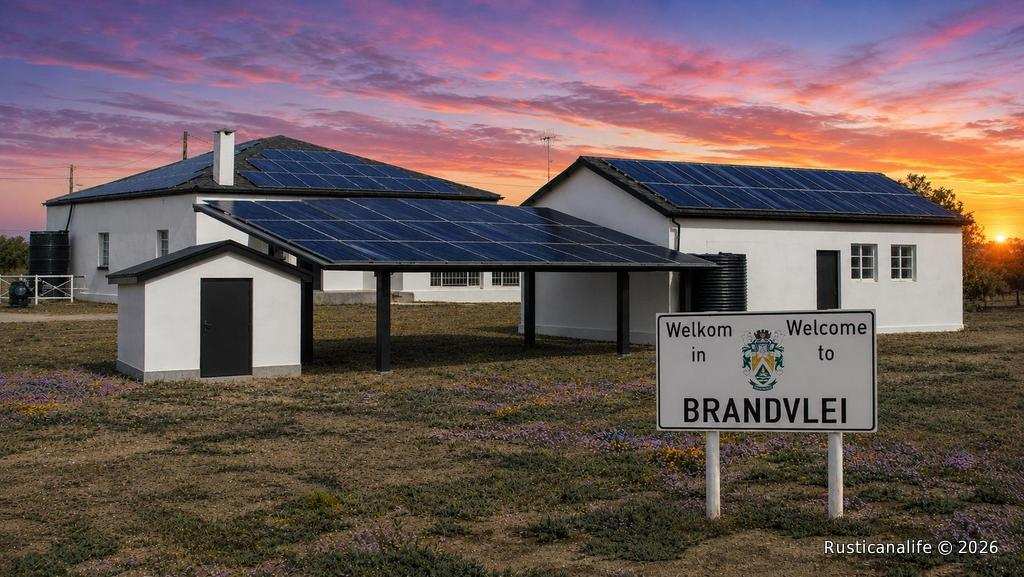
How Brandvlei Can Turn Sunshine Into Total Energy Independence
If you know anything about South Africa’s climate, you probably already know that the Northern Cape is an absolute powerhouse when it comes to sunshine. It’s big, it’s dry, and it gets drenched in sunlight practically every day of the year, making it arguably the single best province for solar capture in the entire country. When you compare it to the rest of South Africa, the contrast across all nine provinces is striking.
At the top of the ladder, the Northern Cape leads with over 3,600 annual hours of sunshine, followed closely by the semi-arid interior provinces of the Free State and North West, which both enjoy around 3,175 hours. Moving slightly east and south, Mpumalanga and the Western Cape sit tied in the middle tier at roughly 3,140 hours per year, though the Western Cape’s famous coastal winter rains create significant seasonal dips compared to the dry northern interior. Limpopo follows with about 3,100 hours, benefiting from strong northern sun despite seasonal cloudiness, while Gauteng averages around 3,060 hours, where crisp, clear winter days offset frequent summer afternoon thunderstorms.
The Eastern Cape averages about 3,030 hours as coastal weather systems roll through, and trailing at the bottom is lush, subtropical KwaZulu-Natal at around 2,480 hours of sunshine per year due to its heavy humidity, cloud cover, and frequent rainfall—meaning the Northern Cape gets over 45 percent more annual sunshine than KwaZulu-Natal. Even compared to strong contenders like the Free State or North West, the Northern Cape offers higher consistency, wider open spaces, and unmatched direct sunlight that easily outperforms every other provincial solar map in South Africa.
If you zoom in on the map, however, not all parts of the Northern Cape are created equal. Sitting right in the heart of the Bushmanland desert is a small town called Brandvlei—and when it comes to solar energy, it leaves almost everywhere else in the country in the dust. Across the entire province, you are already looking at world-class conditions, averaging around 3,000 to 3,600 hours of sunshine a year, which translates to roughly 6 hours of peak solar production every single day, almost double what most of Europe receives.
Then you look at Brandvlei, which pushes those impressive numbers even further by averaging between 6.2 and 6.6-plus peak sun hours a day, beating the already high provincial average by up to 8 percent. While the province as a whole gets great sun, Brandvlei boasts over 3,300 hours of clear sunshine a year, amounting to more than 300 completely cloudless days annually. In practical terms, if you put the exact same solar setup in Brandvlei versus a town on the eastern fringe of the province like Colesberg, the Brandvlei system will produce about 5 to 10 percent more total electricity over the course of a year.
That solar dominance isn’t just about being hot—in fact, extreme heat can actually make solar panels slightly less efficient. Brandvlei’s real secret sauce comes down to a combination of distinct natural advantages. First, sitting roughly 1,000 meters above sea level means there is less atmosphere above it to block or scatter sunlight. Second, humidity acts like a sponge for light, so Brandvlei’s crisp, bone-dry desert air lets raw sunlight hit the ground with virtually no natural filter. Finally, the flat, wide-open landscape means there are no mountain shadows, tall trees, or frequent cloud fronts to cut off power production early in the afternoon.
Yet, there is a stark and painful irony sitting right beneath all this endless sunlight. Despite holding unmatched potential for renewable energy, the Northern Cape remains burdened by severe poverty, where decades of corruption and poorly managed state infrastructure have caused widespread decay, breaking down both old municipal networks and newly built projects. The hardest hit are the poorest of the poor, who are forced to absorb sky-rocketing annual electricity tariffs designed to fund repairs for a decade or more of financial and operational mismanagement. Small, isolated towns like Brandvlei feel this strain acutely; in a community of roughly 4,000 to 5,000 residents where unemployment is high and around 80 percent of people live below the poverty line, basic energy costs take a devastating chunk out of already fragile household budgets.
If left unchecked, state electricity pricing will soon spiral completely out of reach for the average household. That is why the Rusticana Life brains trust believes it is time to take charge, step in with proactive planning, and tap into the abundance of energy right above us. The goal is straightforward: build systems designed to run 90 percent of a home’s power requirements directly from solar, treating fossil fuel generation strictly as a true backup when strictly necessary. To turn this vision into reality in Brandvlei, Rusticana Life is actively exploring a low-voltage 48V DC electrical standard backed by solar panels and lithium battery storage. Instead of relying on energy-hungry alternating current, heavy loads like refrigerators, freezers, and air conditioning units can be stepped down to run directly on 12V or 24V DC.
These highly efficient direct-current appliances are already proven, off-the-shelf technologies widely used in the marine and yachting industries. For heating and cooking, households can seamlessly transition to LPG or even generate their own clean cooking gas using simple biogas digesters fed by fermented fruit and vegetable waste. When you rethink how a home consumes energy, the options for total off-grid resilience are truly endless.
While the Northern Cape is the undisputed solar capital of South Africa, towns like Brandvlei, Kenhardt, and Upington sit right in the centre of the target. It is no wonder energy developers look at this quiet corner of the Karoo as pure gold, as it enjoys some of the cleanest, strongest, and most consistent sunlight found anywhere on Earth. For local residents and forward-thinking initiatives like Rusticana Life, unlocking that immense solar resource means turning a local crisis into absolute energy independence.
- Sources & References
- Global Solar Atlas & Solargis: World Bank Global Solar Atlas – South Africa GIS Data & Solar Maps (Specific DNI, GHI, and PV potential mapping for the Northern Cape and Bushmanland region).
- South African Provincial Solar Irradiation Ranking: SciELO South Africa – Comparative Analysis of Solar Flux across Provinces & MDPI Energies – Solar Irradiance Mapping (Comparative sunshine hours and radiation data across all nine South African provinces).
- CSIR Renewable Energy Development Zones (REDZ): Council for Scientific and Industrial Research – Strategic Environmental Assessment for Wind and Solar PV (Identification of high-yield solar corridors in the Northern Cape interior).
- Hantam Local Municipality Integrated Development & Financial Planning: Hantam Municipality IDP & Annual Performance Report (Demographic profile, unemployment rates, poverty levels, and municipal infrastructure challenges in Brandvlei).
- Poverty Trends & Economic Data: Statistics South Africa – Absolute Poverty & Household Income Trends & Northern Cape Provincial Treasury Analysis (Lower-bound and upper-bound poverty line assessments across rural Northern Cape communities).
- General Climate & Regional Sunshine Statistics: Lithium Batteries SA – Solar Potential Across South Africa & South Africa Info Climate Guide.