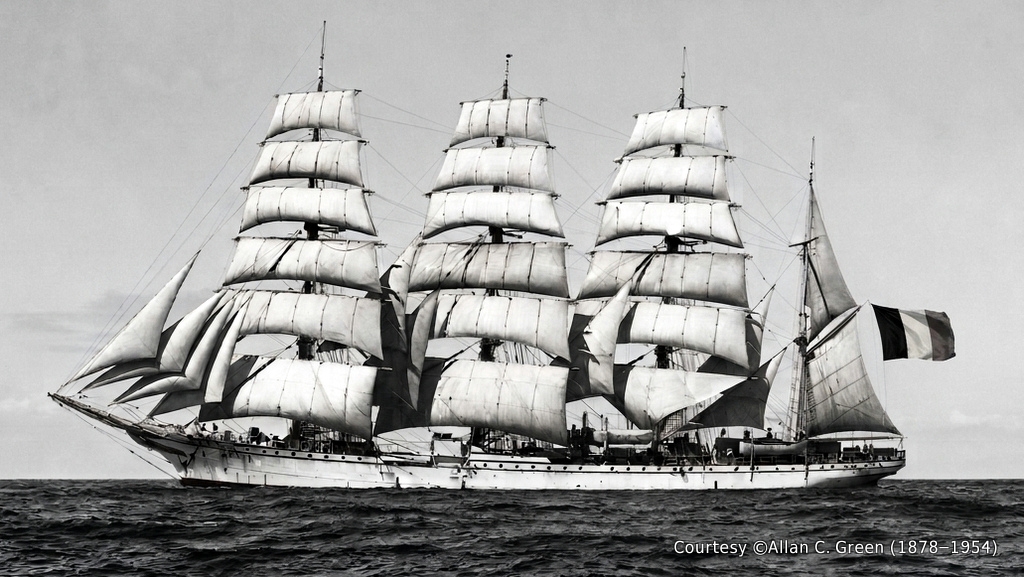
About the Sailing Ship S.V. L’Avenir — the vessel that brought ‘The Future’ into history
This photograph was taken by Allan C. Green (1878–1954), an Australian maritime photographer known for his extensive documentation of ships and sailing vessels. The original physical glass negative is held in the public domain collection of the State Library of Victoria (Accession Number: H91.108/1276).
The S.V. L’Avenir was launched in 1908 at the well-known R.C. Rickmers shipyard in Geestemünde, Germany, and was a splendid four-masted steel barque built at a crucial time in maritime transport history. It was commissioned by the Association Maritime Belge of Antwerp. It was intended to carry out two important functions: that of a deep-sea commercial merchant ship and that of a training vessel for the next generation of merchant officers.
The fact that her French name was L’Avenir—which means ‘The Future’—was suitable in view of her aim. She was a symbol of Belgium’s determination to prepare young seafarers for the rapidly changing world of international commerce by giving cadets the chance to gain knowledge of their profession on a modern sailing ship capable of making demanding ocean journeys.
For nearly a quarter of a century, the ship L’Avenir had been navigating the world’s trade routes, transporting general cargo, and at the same time had given practical seamanship training to hundreds of young cadets. She was fitted with auxiliary wireless communication and had a highly developed sailing rig which was designed to obtain every possible knot of speed from the wind. Because of her size, her performance and her elegant lines, she became one of the most impressive and well-kept tall ships of the early twentieth century.
The era in which L’Avenir had been born was already starting to vanish.
In the 1930s, the great shift from sail to steam was well advanced. Steamships were able to keep to their schedules regardless of the wind and were becoming more and more dominant in international trade. The magnificent commercial sailing ships which had previously linked up the world’s ports were slowly being driven towards obsolescence.
It was in this transitional phase that the L’Avenir joined the fleet of Gustaf Erikson, one of the most renowned figures in the history of commercial sailing.
In 1932 Erikson bought the ship and added her to his well-known fleet of Åland windjammers. Rather than being sent straight into retirement, L’Avenir went on to show off the outstanding abilities of a well-managed sailing ship and joined the last generation of vessels to take part in the tough ‘Great Grain Race’, transporting Australian wheat across the Southern Ocean and round Cape Horn to the European markets.
They were some of the final major trials of traditional seamanship for sailing at sea. The crews had to rely on the wind, on their knowledge of the oceans and on their ability to navigate thousands of miles of open water with only a small amount of mechanical help. Although the ships were magnificent, the trade was severe since storms, huge seas, ice and the isolation of the Southern Ocean continued to pose constant dangers.
For L’Avenir, there was still another chapter waiting.
In 1937, the Hamburg America Line (HAPAG) acquired her and got her back into service with Germany as a vessel for training sailors. She was renamed Admiral Karpfanger and once again took on young officer cadets, thus carrying out nearly three decades earlier the very purpose for which she had originally been built.
The last time she set out to sea was in early 1938.
After having loaded a full cargo of grain at Port Germein in South Australia, Admiral Karpfanger set sail for what was supposed to be another long journey to Europe. There were sixty crew members and officer cadets on board. Her planned route was to go south and east across the huge Southern Ocean, round the difficult waters of Cape Horn, and then turn north towards Europe.
She never arrived.
In March 1938, the ship sent out what was to prove to be her last wireless message, after which Admiral Karpfanger vanished without a trace.
The Southern Ocean provided no clues.
Some months later, pieces of the wreckage and the scattered debris were found along the shores of Tierra del Fuego. The evidence indicates that the ship might have come across an iceberg in the extremely hazardous waters around Cape Horn. Whatever exactly took place, the large sailing vessel and all those on board it were lost.
The fact that the ship had disappeared marked the tragic conclusion of a career which had spanned almost thirty years aboard some of the most difficult oceans in the world.
The story of L’Avenir—’The Future’—is reflected in that of Admiral Karpfanger and shows the transformation of maritime history; she was born in an age when sailing still dominated the world’s oceans, worked as a merchant vessel and as a training ship, lasted through the last years of the large wind-powered ships, and finally vanished at a time when steam and motor ships had already started to determine the future of international shipping.
It is that which makes her story so compelling.
L’Avenir was constructed with the aim of representing the future; instead, she became a remarkable part of the history of the past, a splendid testament to the courage, skill and endurance displayed by those who once sailed the world’s oceans under canvas.
More than eight decades after her disappearance, the name L’Avenir still calls up the romance and tragedy of the last period of commercial sailing. The mystery surrounding her fate is one of the lasting enigmas of twentieth-century maritime history, and her story continues to inspire those who are interested in the great ships—and the men who sailed them—of the final age of sail.